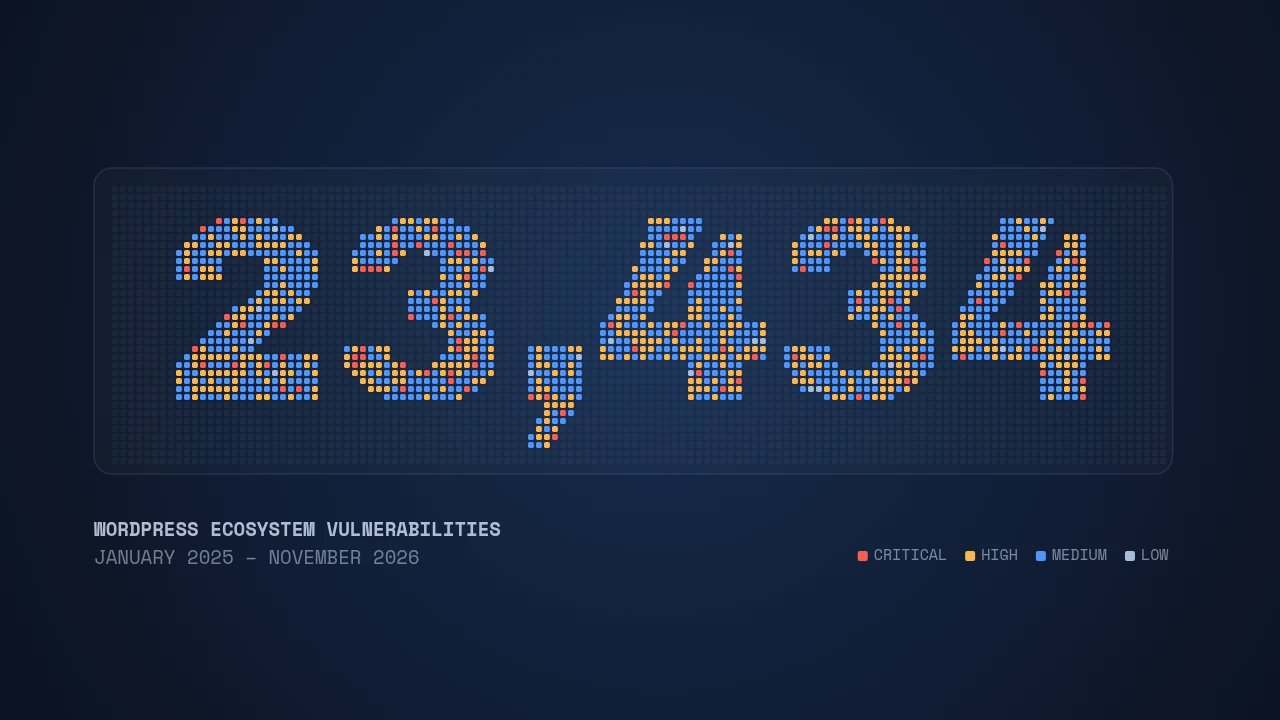
Over half of all WordPress sites are running a version of PHP that will be out of official support by January. About a third are already on versions the PHP project has stopped fixing,1 and PHP 8.2, the second most popular version, joins them when its support ends on 31 December.2 It has been a lot worse, though. Just after PHP 7.4 reached end of life in 2022, the figure was closer to nine in ten.3
The title comes from PHP's mascot, an elephant called the ElePHPant.4 The elephant in the room, as I see it, is how much old PHP is still out there, and how much of it only gets patched because Linux distributions, paid support services and hosts carry on fixing it behind the scenes, often without site owners knowing. October's PHP2Shell scare showed how much good that can do, and also how much of it relied on people going out of their way to help, because when more critical fixes came out four weeks later the PHP project left the old versions out. Plugins aren't waiting either, with WooCommerce and Contact Form 7 both moving on from old PHP whatever the host does.
31%
of WordPress sites run a PHP version the PHP project no longer fixes
53%
are on PHP that will be out of official support by 1 January
14%
are still on PHP 7.4, which the PHP project stopped fixing on 28 November 2022
5 of 5
times WordPress has raised its minimum PHP version since 2011, the new minimum was already past end of life
Which PHP versions are WordPress sites running?
PHP 8.3 is the most common version, on 28% of sites, with 8.2 close behind. The surprise is in third place, where PHP 7.4 is still on 14% of WordPress sites four years after the PHP project stopped fixing it, which is more than PHP 8.4, even though 8.4 has been out for two years.5
Share of WordPress sites on each PHP version
| 5.x and older | 1.9% |
|---|---|
| 7.0 | 0.5% |
| 7.1 | 0.3% |
| 7.2 | 1.2% |
| 7.3 | 1.2% |
| 7.4 | 13.9% |
| 8.0 | 3.2% |
| 8.1 | 8.8% |
| 8.2 | 22.1% |
| 8.3 | 28.3% |
| 8.4 | 11.3% |
| 8.5 | 7.1% |
| 8.6 | 0.1% |
PHP 8.6 only came out on 19 November, so it's barely registering yet.6
When each version stops getting fixes
The PHP project gives each version two years of normal bug fixes, then two more years of security fixes only.2 After that it's "end of life", which in PHP's own words means users "may be exposed to unpatched security vulnerabilities".
If nobody upgraded at all, more than half of WordPress sites would be past official support on 1 January, and four in five a year later when PHP 8.3 runs out too. People do upgrade, of course, so that's a worst case rather than a forecast. Between the 2 November snapshot and today, the share of sites on 8.2 or older fell by about 2.4 points, and if it carried on at that pace the figure on 1 January would be nearer 50% than 53%.
October: PHP2Shell and an exception for old PHP
What end of life means in practice got tested twice this autumn. On 21 October the PHP project fixed two critical bugs, together known as PHP2Shell, that could let someone run their own code on a server without logging in.7 Details had leaked the day before,8 and it was serious enough that government sites in several European countries were taken offline as a precaution.9 I covered it at the time in that week's This week in WordPress.
The official fixes were for PHP 8.2 to 8.5, but the PHP project also made an exception for older versions: "Given the severity of these vulnerabilities, the PHP security team provided minimal source-backports for PHP 7.4, PHP 8.0, and PHP 8.1".7 It didn't have to, and I don't think anyone could have complained if it hadn't.
The companies that look after older PHP for a living went further still. Ubuntu fixed every version it supports, back to PHP 5.5 on Ubuntu 14.04 (through its paid Ubuntu Pro subscription for 20.04 and older),10 and CloudLinux, which makes an operating system for shared hosting, shipped fixed builds of all 16 PHP versions its customers use, from 5.2 to 8.5.11 Its reasoning is that a shared server holds hundreds of accounts, each pinned to whatever PHP version its site was built for, and forcing them all onto a new one breaks sites.
PHP2Shell, day by day
-
- Attacks and alerts: Amazon's honeypots record the first exploitation attempt, four days before the bugs were made public.
-
- Attacks and alerts: Details leak on social media ahead of the planned 22 October disclosure.
- PHP 8.2 to 8.5: PHP pre-announces a critical security release, brought forward to the next day because of the leak.
-
- Attacks and alerts: Amazon sees proof-of-concept exploits and more attempts from 02:00 UTC, before any fix is out. Government, school and hospital sites in several European countries are taken offline as a precaution.
- PHP 8.2 to 8.5: PHP 8.2.35, 8.3.36, 8.4.27 and 8.5.12 come out at about 13:30 UTC.
- PHP 7.4 to 8.1: PHP publishes minimal source patches for 7.4, 8.0 and 8.1, which hosts and Linux distributions still have to build and ship.
- Ubuntu: Fixes for every supported release, with 20.04 and older through Ubuntu Pro.
- cPanel and Plesk: cPanel's EasyApache 4 and Plesk ship 8.2 to 8.5 plus backported fixes for 7.4, 8.0 and 8.1.
- CloudLinux and TuxCare: TuxCare's first fixed packages go out at 16:46 UTC, and CloudLinux's cPanel builds for PHP 5.2 to 8.5 at 20:55 UTC.
- WP Engine: Protective rules go up at WP Engine's CDN and patching starts.
-
- CloudLinux and TuxCare: CloudLinux's alt-php builds for 5.2 to 8.5 reach its stable repositories just after midnight UTC, and its last native PHP packages that evening.
- WP Engine: Patching finishes at 01:19 UTC, including PHP 7.4.
- Attacks and alerts: Wordfence reports more than 74,000 exploit or probing attempts blocked, with no confirmed compromises.
-
- Attacks and alerts: CISA adds both bugs to its list of known exploited vulnerabilities.
November: no exception this time
Four weeks later, on 19 November, PHP put out another batch of security fixes, seven of them rated critical.12 Most need a fairly unusual setup to be exploited, but on some server configurations one could let someone run code on the server through an ordinary WordPress request.13
This time the fixes were for 8.2 to 8.5 only. CloudLinux again shipped builds for its old versions,14 but where a host doesn't use something like it, there may be nobody patching an old version for these bugs.
Who still patches old PHP
Once the PHP project stops fixing a version, fixes can still come from three other places, and which of them applies (if any) depends on the host.
- Your server's Linux distribution. Distributions such as Ubuntu keep fixing the PHP they ship on their own timetable, so Ubuntu 22.04 still fixes PHP 8.1, and 20.04 still fixes 7.4 through its Ubuntu Pro subscription.10 That only helps if the host uses the distribution's own PHP, and many shared hosts don't, because they offer several versions side by side.11
- A paid extended support service. TuxCare, part of CloudLinux, sells extended support for PHP 5.2 to 8.5, which hosts pay for as a yearly licence. It aims to fix critical bugs within 14 days, had PHP2Shell fixes out on the same day, and stops sending fixes if the licence lapses.15
- The host's own promise. WP Engine announced in 2022 that it would keep supporting PHP 7.4 "into 2024".16 It still offers 7.4 today and patched it for PHP2Shell, though I couldn't find anything saying for how long.17
Fixes like these usually keep the old version number,18 so a patched PHP 7.4 and an unpatched one look exactly the same from inside WordPress. When I call a version unsupported in this post, I mean the PHP project has stopped fixing it, and only the host can say whether someone else still is.
Are plugins moving on from old PHP?
Plugins on WordPress.org each say which version of PHP they need, and WordPress normally won't update a plugin to a version that needs newer PHP than the site has,19 so a site on older PHP stops getting that plugin's updates altogether, new features and bug fixes as well as security fixes. I pulled that setting for the 1,000 most popular plugins to see how many have moved on.20
Most haven't, with 94% of them still saying they'll run on PHP 7.4 or older (or not giving a minimum at all) and only six needing PHP 8.3.
A few very big ones are moving, though. WooCommerce 11.6, due in February, needs PHP 8.1, and shops on 7.4 or 8.0 will be stuck on 11.5, which will only get fixes for the most severe vulnerabilities.19 WooCommerce announced that in September, which is a fair bit of notice. Hostinger's own plugin, on more than 3 million sites, already needs 8.1.
Contact Form 7, on more than 10 million sites, moved faster, jumping from PHP 7.4 to 8.3 in version 6.2 in October.21 That follows a policy its developer published last December of requiring whatever PHP version WordPress recommends,22 but it rules out about 53% of WordPress sites, including everyone on PHP 8.2, which still has official support. Several recent reviews say an automatic update took their sites down,23 even though WordPress normally holds back a plugin update the site's PHP can't run.
None of the other big names I checked, including Elementor, Yoast SEO, Wordfence, Jetpack, Rank Math, WPForms, Gravity Forms and ACF, has announced a change yet, though Elementor and Gravity Forms already recommend 8.3,24 and these minimums can go up in any update.
How quickly sites move on
Old PHP hanging around on WordPress sites is nothing new. WordPress.org only publishes today's figures, but the Internet Archive has been saving copies since 2017, and WordPress.org published a full set in 2015.25
Share of WordPress sites on each PHP version since 2015
Dashed lines: when the PHP project stopped fixing 5.6, 7.4 and 8.1. Dots are the dates there are figures for, and dotted stretches are gaps with none. Pick a version to highlight it
| Date | 5.2 | 5.3 | 5.4 | 5.5 | 5.6 | 7.0 | 7.1 | 7.2 | 7.3 | 7.4 | 8.0 | 8.1 | 8.2 | 8.3 | 8.4 | 8.5 |
|---|---|---|---|---|---|---|---|---|---|---|---|---|---|---|---|---|
| 1 Mar 2015 | 16.6% | 38.5% | 37.2% | 6.5% | 1.3% | |||||||||||
| 28 Aug 2017 | 4.3% | 11.4% | 17.9% | 11% | 40.7% | 11.9% | 2.8% | |||||||||
| 27 Sep 2017 | 4.1% | 10.9% | 17.2% | 10.7% | 40.8% | 12.8% | 3.5% | |||||||||
| 16 Apr 2019 | 1.9% | 4.9% | 8.4% | 4.8% | 31.8% | 18% | 12.7% | 15.8% | 1.8% | |||||||
| 8 May 2019 | 1.9% | 4.7% | 8.2% | 4.5% | 31.3% | 17.7% | 12.8% | 16.6% | 2.2% | |||||||
| 1 Aug 2019 | 1.6% | 4% | 6.9% | 3.6% | 29% | 16.1% | 13.2% | 19.3% | 6.2% | |||||||
| 9 Oct 2019 | 1.5% | 3.6% | 5.9% | 2.9% | 25.3% | 14.8% | 13.5% | 22.4% | 10% | |||||||
| 2 May 2020 | 1.1% | 2.5% | 4% | 1.9% | 18% | 12.6% | 9.5% | 24.5% | 23.3% | 2.7% | ||||||
| 11 Aug 2020 | 0.9% | 2.2% | 3.4% | 1.6% | 15.3% | 10.7% | 8.2% | 24% | 25.6% | 8.2% | ||||||
| 28 Jul 2021 | 0.5% | 1.2% | 1.2% | 0.9% | 8.6% | 5% | 3.7% | 14.7% | 24.9% | 38.4% | 0.8% | |||||
| 15 Aug 2021 | 0.5% | 1.2% | 1.2% | 0.9% | 8.4% | 4.9% | 3.6% | 14.2% | 24.6% | 39.6% | 0.9% | |||||
| 10 Feb 2022 | 0.4% | 1% | 0.9% | 0.7% | 7.1% | 4% | 2.9% | 11.6% | 20.6% | 48.1% | 2.7% | 0.2% | ||||
| 13 Jul 2022 | 0.3% | 0.8% | 0.7% | 0.6% | 6% | 3.3% | 2.3% | 9.6% | 15.1% | 54.1% | 5.9% | 1.1% | ||||
| 9 Dec 2022 | 0.3% | 0.7% | 0.6% | 0.5% | 5.1% | 2.7% | 1.8% | 7.8% | 11% | 56.7% | 9.1% | 3.6% | 0% | |||
| 13 Feb 2023 | 0.3% | 0.7% | 0.6% | 0.5% | 4.6% | 2.5% | 1.7% | 7.2% | 9.9% | 55% | 11.1% | 5.5% | 0.3% | |||
| 19 Apr 2023 | 0.3% | 0.6% | 0.6% | 0.5% | 4.3% | 2.3% | 1.6% | 6.4% | 8.9% | 53.4% | 12.7% | 7.6% | 0.9% | |||
| 15 Jun 2023 | 0.2% | 0.6% | 0.5% | 0.4% | 4% | 2.1% | 1.4% | 6.5% | 8.2% | 51.6% | 13.6% | 9.1% | 1.7% | |||
| 27 Aug 2023 | 0.2% | 0.6% | 0.5% | 0.4% | 3.7% | 1.9% | 1.3% | 5.6% | 7.3% | 49.9% | 14.9% | 10.2% | 3.4% | |||
| 30 Nov 2023 | 0.2% | 0.5% | 0.5% | 0.4% | 3.3% | 1.7% | 1.1% | 5.1% | 6.2% | 47.4% | 14.3% | 13.1% | 6.2% | 0% | ||
| 25 Jun 2024 | 0.2% | 0.4% | 0.4% | 0.3% | 2.7% | 1.4% | 0.9% | 3.4% | 4.2% | 40.3% | 10.9% | 19.2% | 13.5% | 2.4% | ||
| 17 Sep 2024 | 0.2% | 0.4% | 0.3% | 0.3% | 2.4% | 1.2% | 0.8% | 3% | 3.7% | 35.5% | 10.2% | 20.1% | 18.2% | 3.8% | ||
| 13 Mar 2025 | 0.2% | 0.4% | 0.3% | 0.2% | 2.1% | 1% | 0.6% | 2.5% | 2.9% | 30.9% | 9.3% | 19.1% | 22.1% | 7.8% | 0.5% | |
| 22 May 2025 | 0.2% | 0.3% | 0.3% | 0.2% | 2% | 0.9% | 0.6% | 2.2% | 2.6% | 29% | 8.7% | 18.2% | 24.7% | 8.9% | 1.1% | |
| 10 Jan 2026 | 0.1% | 0.3% | 0.2% | 0.2% | 1.6% | 0.7% | 0.5% | 1.8% | 2% | 22.1% | 5.6% | 15.4% | 27.3% | 16.8% | 4.9% | 0.2% |
| 25 Feb 2026 | 0.1% | 0.3% | 0.2% | 0.2% | 1.6% | 0.7% | 0.4% | 1.7% | 1.9% | 21.1% | 5.2% | 14.6% | 26.6% | 18.7% | 5.8% | 0.7% |
| 27 Sep 2026 | 0.1% | 0.3% | 0.2% | 0.2% | 1.3% | 0.6% | 0.4% | 1.4% | 1.4% | 16.7% | 4% | 11.1% | 24.5% | 25.7% | 8.8% | 3.3% |
| 2 Nov 2026 | 0.1% | 0.2% | 0.2% | 0.1% | 1.3% | 0.5% | 0.3% | 1.3% | 1.3% | 14.8% | 3.4% | 9.3% | 22.8% | 27.6% | 10.4% | 6.1% |
| 28 Nov 2026 | 0.1% | 0.2% | 0.2% | 0.1% | 1.2% | 0.5% | 0.3% | 1.2% | 1.2% | 13.9% | 3.2% | 8.8% | 22.1% | 28.3% | 11.3% | 7.1% |
Back in March 2015, more than half of WordPress sites were on PHP 5.2 or 5.3, both of which the PHP project had already stopped fixing, and 5.2 had been out of support for over four years. PHP 5.6 took over after that, and was still on a quarter of sites nine months after its own support ended.
PHP 7.4 has been the odd one out since then. It peaked on 57% of WordPress sites in December 2022, right around the time the PHP project stopped fixing it, and no version since has come close.
A few things lined up for 7.4. It's sometimes remembered as a long-term support release, but PHP has never had those. The LTS was Ubuntu's, as Ubuntu 20.04 LTS and Debian 11 both shipped 7.4 as their default,26 and WordPress's own requirements page kept recommending it until July 2025.27 PHP 8.0 was a harder move too, with more breaking changes, which may be why it never got above 15% of sites and a lot of them seem to have skipped it.28
Share of WordPress sites on PHP past official support
Dashed lines: a PHP version reaches end of life (the last one is 8.2, on 31 December). Dotted stretches are gaps with no figures
| Date | Past official support |
|---|---|
| 1 Mar 2015 | 55.1% |
| 28 Aug 2017 | 44.6% |
| 27 Sep 2017 | 42.9% |
| 16 Apr 2019 | 69.7% |
| 8 May 2019 | 68.4% |
| 1 Aug 2019 | 61.3% |
| 9 Oct 2019 | 54.1% |
| 2 May 2020 | 49.5% |
| 11 Aug 2020 | 42.3% |
| 28 Jul 2021 | 35.8% |
| 15 Aug 2021 | 34.9% |
| 10 Feb 2022 | 49% |
| 13 Jul 2022 | 38.8% |
| 9 Dec 2022 | 87.3% |
| 13 Feb 2023 | 83% |
| 19 Apr 2023 | 78.8% |
| 15 Jun 2023 | 75.6% |
| 27 Aug 2023 | 71.4% |
| 30 Nov 2023 | 80.7% |
| 25 Jun 2024 | 64.9% |
| 17 Sep 2024 | 57.9% |
| 13 Mar 2025 | 50.5% |
| 22 May 2025 | 47% |
| 10 Jan 2026 | 50.7% |
| 25 Feb 2026 | 48.1% |
| 27 Sep 2026 | 37.6% |
| 2 Nov 2026 | 32.9% |
| 28 Nov 2026 | 31.2% |
| 1 Jan 2027 (on 1 January if nobody moves) | 53% |
Every time a popular version reaches end of life, the share of sites past official support jumps and then drifts slowly back down. PHP 7.4's end of life took it to 87% in December 2022, and today's 31% is the lowest in any snapshot back to 2015, until January adds everything still on 8.2.
How long WordPress itself supports old PHP
WordPress has its own minimum PHP version, and it has always sat well behind PHP's own support. Every time WordPress has raised its minimum PHP version since 2011, the new minimum has been a version the PHP project had already stopped fixing.
How long WordPress kept supporting each minimum PHP version after the PHP project stopped
| Name | Start | The PHP project's own support until | Ends | Note |
|---|---|---|---|---|
| 5.2 | 2 Nov 2006 | 6 Jan 2011 | 7 May 2019 (ended) | Until WP 5.2 |
| 5.6 | 28 Aug 2014 | 31 Dec 2018 | 8 Aug 2023 (ended) | Until WP 6.3 |
| 7.0 | 3 Dec 2015 | 10 Jan 2019 | 16 Jul 2024 (ended) | Until WP 6.6 |
| 7.2 | 30 Nov 2017 | 30 Nov 2020 | 20 May 2026 (ended) | Until WP 7.0 |
| 7.4 | 28 Nov 2019 | 28 Nov 2022 | 28 Nov 2026 | Still supported |
WordPress kept PHP 5.2 as its minimum until 2019,29 more than eight years after the PHP project stopped fixing it, which is a very long time in web years. The current minimum, PHP 7.4, lost official support four years ago.
WordPress does this on purpose, waiting until a PHP version is on under 5% of sites before dropping it so it doesn't break a load of sites overnight, which I think is fair enough. Sites that do get left behind stay on the last version of WordPress that supports them, which only gets security fixes "as a courtesy when possible".30
It does cost WordPress something. When WordPress 5.2 raised the minimum in 2019, its release notes told developers they could finally "safely take advantage of namespaces, anonymous functions, and more",29 both of which had arrived in PHP 5.3 ten years earlier.31 It hasn't stopped WordPress keeping up at the other end, though, and 6.9 and 7.0 fully support PHP 8.5.32
WordPress supporting a version only means WordPress runs on it. PHP 7.4 is supported as far as WordPress is concerned, but it hasn't had an official fix from the PHP project since 2022, and WordPress's own recommendation is 8.3 or newer.30
I suspect that gap is part of why sites move so slowly. If WordPress is happy, the control panel is happy and the site works, it's easy to read "WordPress supports it" as "it's fine". PHP developer Juliette Reinders Folmer called it a "chicken vs egg" situation back in 2020: WordPress waits for sites to move before dropping a version, and a lot of sites don't move "until they really have to because WordPress drops support for the version".33 WordPress said something similar this May, when it dropped the "beta" label from its PHP 8 support because it "made some end users and web hosts reluctant to update to newer versions of PHP".32
Speed, hosting costs and the risk of upgrading
Security fixes and plugin updates aren't the only things the PHP version affects. Newer PHP is usually a bit faster too, though by less than you might expect. In Kinsta's latest benchmarks (December 2025), a plain WordPress install was only about 7% faster on PHP 8.5 than on 7.4, with almost nothing between 8.2 and 8.5, though WooCommerce gained more, at a little over 20% on 8.2 to 8.4.34 Tideways found much the same.35 A real site with plugins and caching will see different numbers, so I'd treat speed as a nice extra rather than a reason on its own.
| PHP | WordPress 6.8 | WooCommerce 10.2 |
|---|---|---|
| 7.4 | 139.1 | 44.2 |
| 8.2 | 146.1 (+5%) | 54.7 (+24%) |
| 8.3 | 142.8 (+3%) | 53.7 (+22%) |
| 8.4 | 148.2 (+7%) | 53.4 (+21%) |
| 8.5 | 148.3 (+7%) | 71.0 (+61%, see note) |
Hosts are starting to push as well. IONOS charges £15.62 a month for extended support on PHP 7.4 and 8.0 (IONOS UK's PHP hosting page, checked 28 November 2026),36 and GoDaddy adds a paid add-on at renewal for sites on end-of-life PHP.37 Others just move sites on, as Pressable did with PHP 8.1 last December38 and WP Engine does with automatic upgrades that "cannot be deferred",39 while Kinsta keeps 7.4 and 8.0 going for free.40 With 8.2 reaching end of life in a month, I'd expect more hosts to announce something soon.
None of this makes upgrading free of risk. PHP 8.0 in particular removed some old functions and turned several warnings into errors, which is the usual reason older plugins and themes break, and each version since has deprecated a few more things.28 WordPress's own guide is honest about it: "Updating your PHP version should not be a problem, but we can't guarantee that it's not."41
Why patched old PHP only buys time
Hosts and the companies behind them deserve credit for keeping old PHP patched. Forcing an old site onto new PHP with no warning can break it, and a host that kept 7.4 running and patched it in October did right by a lot of small sites that would otherwise have had no fix that week.
It isn't something to lean on for long, though. In October the PHP project made an exception, in November it didn't, and there's nothing to say which way it'll go next time. An old version also only stays patched if the host gets its PHP from a Linux distribution or a support service that still fixes it, keeps paying for it, installs the fixes quickly and restarts PHP afterwards,10 none of which is easy to see from the outside, and since nothing visibly changes, there's little to prompt anyone to move.
It would help a lot if every host that still offers an end-of-life PHP version said so on a public page: which versions it's still patching, who the fixes come from, how long it'll carry on and when it'd like people to move. WP Engine saying publicly that it would support 7.4 past its end of life is the kind of thing I mean, though that announcement was last updated in December 2023,16 and it'd be good to see more hosts do the same and keep it up to date.
Plugins are the bigger issue, because they're moving on whether hosts keep old PHP alive or not. A patched server does nothing for an old plugin that can't be updated, and as my WordPress vulnerability statistics showed, plugins are where almost all the security bugs are. Patched old PHP is a good safety net when something like PHP2Shell happens, and a reasonable way to buy time while a site gets upgraded, rather than somewhere to stay.
Checking your own site
WordPress shows which PHP version a site is on under Tools › Site Health › Info › Server,42 and WooCommerce shows it under WooCommerce › Status too.19
What your PHP version means
Which PHP version is your site on?
Official fixes for PHP 7.3 ended 5 years ago
Official security fixes ended on 6 December 2021.
- WordPress sites on these versions
- 5.1%
- WordPress sites on this version or older
- 5%
- Official PHP2Shell fix, October 2026
- No
- Official security fixes, November 2026
- No
- WooCommerce 11.6, due February 2027
- Needs PHP 8.1, stuck on 11.5
- Contact Form 7 6.2 and newer
- Needs PHP 8.3, stuck on 6.1.7
- Top 1,000 plugins that need newer PHP
- At least 487
The PHP project no longer fixes this version, so whether it still gets security fixes depends on the host and where its PHP comes from.
Official fixes ended 4 years ago
Official security fixes ended on 28 November 2022.
- WordPress sites on this version
- 13.9%
- WordPress sites on this version or older
- 19%
- Official PHP2Shell fix, October 2026
- Source patch only
- Official security fixes, November 2026
- No
- WooCommerce 11.6, due February 2027
- Needs PHP 8.1, stuck on 11.5
- Contact Form 7 6.2 and newer
- Needs PHP 8.3, stuck on 6.1.7
- Top 1,000 plugins that need newer PHP
- 58
The PHP project no longer fixes this version, so whether it still gets security fixes depends on the host and where its PHP comes from.
Official fixes ended 3 years ago
Official security fixes ended on 26 November 2023.
- WordPress sites on this version
- 3.2%
- WordPress sites on this version or older
- 22%
- Official PHP2Shell fix, October 2026
- Source patch only
- Official security fixes, November 2026
- No
- WooCommerce 11.6, due February 2027
- Needs PHP 8.1, stuck on 11.5
- Contact Form 7 6.2 and newer
- Needs PHP 8.3, stuck on 6.1.7
- Top 1,000 plugins that need newer PHP
- 33
The PHP project no longer fixes this version, so whether it still gets security fixes depends on the host and where its PHP comes from.
Official fixes ended 11 months ago
Official security fixes ended on 31 December 2025.
- WordPress sites on this version
- 8.8%
- WordPress sites on this version or older
- 31%
- Official PHP2Shell fix, October 2026
- Source patch only
- Official security fixes, November 2026
- No
- WooCommerce 11.6, due February 2027
- Works
- Contact Form 7 6.2 and newer
- Needs PHP 8.3, stuck on 6.1.7
- Top 1,000 plugins that need newer PHP
- 18
The PHP project no longer fixes this version, so whether it still gets security fixes depends on the host and where its PHP comes from.
about a month of official fixes left
Security fixes only, until 31 December 2026.
- WordPress sites on this version
- 22.1%
- WordPress sites on this version or older
- 53%
- Official PHP2Shell fix, October 2026
- Yes
- Official security fixes, November 2026
- Yes
- WooCommerce 11.6, due February 2027
- Works
- Contact Form 7 6.2 and newer
- Needs PHP 8.3, stuck on 6.1.7
- Top 1,000 plugins that need newer PHP
- 6
The PHP project no longer fixes this version, so whether it still gets security fixes depends on the host and where its PHP comes from.
1 year, 1 month of official fixes left
Security fixes only, until 31 December 2027.
- WordPress sites on this version
- 28.3%
- WordPress sites on this version or older
- 81%
- Official PHP2Shell fix, October 2026
- Yes
- Official security fixes, November 2026
- Yes
- WooCommerce 11.6, due February 2027
- Works
- Contact Form 7 6.2 and newer
- Works
- Top 1,000 plugins that need newer PHP
- 0
The PHP project no longer fixes this version, so whether it still gets security fixes depends on the host and where its PHP comes from.
2 years, 1 month of official fixes left
Bug and security fixes until 31 December 2026, then security fixes only until 31 December 2028.
- WordPress sites on this version
- 11.3%
- WordPress sites on this version or older
- 93%
- Official PHP2Shell fix, October 2026
- Yes
- Official security fixes, November 2026
- Yes
- WooCommerce 11.6, due February 2027
- Works
- Contact Form 7 6.2 and newer
- Works
- Top 1,000 plugins that need newer PHP
- 0
The PHP project no longer fixes this version, so whether it still gets security fixes depends on the host and where its PHP comes from.
3 years, 1 month of official fixes left
Bug and security fixes until 31 December 2027, then security fixes only until 31 December 2029.
- WordPress sites on this version
- 7.1%
- WordPress sites on this version or older
- 100%
- Official PHP2Shell fix, October 2026
- Yes
- Official security fixes, November 2026
- Yes
- WooCommerce 11.6, due February 2027
- Works
- Contact Form 7 6.2 and newer
- Works
- Top 1,000 plugins that need newer PHP
- 0
The PHP project no longer fixes this version, so whether it still gets security fixes depends on the host and where its PHP comes from.
Many hosts let you change the PHP version from the control panel. Old plugins and themes can break on newer PHP,11 which is why the change is usually tested on a staging copy with a backup in place. My guide to updating your PHP version in WordPress goes through how it all works, and my guide to the WordPress critical error screen covers what to look at if a site shows an error afterwards.
A plugin that won't work on newer PHP can be a sign it's no longer maintained. My guide on what to do when a plugin is closed or abandoned covers the options.
How I got these numbers
- PHP versions on WordPress sites come from WordPress.org's PHP version statistics, read on 28 November 2026.1 They're based on the WordPress sites that check in with WordPress.org for updates,43 so sites that have turned that off aren't counted. Figures are rounded, so they may not add up to exactly 100%.
- PHP versions over time come from 26 copies of WordPress.org's PHP statistics saved by the Internet Archive's Wayback Machine between August 2017 and November 2026,3 plus the figures WordPress.org published in March 201525 and today's figures. The 2015 figures were the first after WordPress.org stopped counting sites that no longer check in. The snapshots aren't evenly spaced, and there are none between March 2015 and August 2017, so the charts join up the points there are (shown as dots) and can't show exactly when each jump happened. "Past official support" at each date adds up the versions whose official security fixes had ended by then.
- Plugin PHP requirements are the "Requires PHP" setting of the 1,000 plugins with the most active installs, from the WordPress.org plugins API on 28 November 2026.20 That's what each plugin says it needs, not what it has been tested on. Contact Form 7's old and new minimums are from its readme files.44
- WordPress's minimum PHP versions come from WordPress's release notes for 3.245 and 5.229 and the Make WordPress Core announcements for 6.3,46 6.647 and 7.0,30 with WordPress release dates from its releases page and PHP release dates from php.net.48
- Support dates come from php.net's supported versions and unsupported branches pages, checked on 28 November 2026. "Officially supported" means the PHP project itself still releases security fixes for that version. Hosts, Linux distributions and extended support services may patch older versions on their own.
- What was patched in October and November comes from the PHP project's announcements49 and the published updates from Ubuntu, CloudLinux, cPanel50 and Plesk.51 The PHP2Shell timeline also uses Amazon's52 and watchTowr's write-ups, the CloudLinux and TuxCare status page,53 WP Engine's status page (read through the Internet Archive), Wordfence54 and CISA's catalogue,55 with times converted to UTC. Other Linux distributions and control panels made their own choices, which I haven't tried to cover.
- Speed and host policies come from Kinsta's and Tideways' published WordPress benchmarks and the hosts' own pages, checked 28 November 2026. I haven't run any benchmarks myself, and those tests use a plain WordPress install, so a real site with plugins and caching will see different numbers.
- Other kinds of support come from TuxCare's and cPanel's pages on extended PHP support,56 checked 28 November 2026, and WP Engine's PHP 7.4 announcement and PHP guide. I've only included hosts that have published something about it, so other hosts may well be doing the same without saying so.
Common questions
What PHP version should my WordPress site use?
It depends on what the site's plugins and theme support. Of the versions with official support, PHP 8.3 gets security fixes until the end of 2027, 8.4 until the end of 2028 and 8.5 until the end of 2029. PHP 8.6 only came out in November 2026, and PHP 8.2's official support ends on 31 December 2026.
Is PHP 7.4 still safe to use?
The PHP project stopped fixing it in November 2022, so any security fixes now depend on the host. Some hosts still get it patched through their Linux distribution or a paid extended support service, and many did for PHP2Shell in October 2026. Plugins are starting to drop it too, including WooCommerce from February 2027, which means sites on 7.4 can't update those plugins any further.
Will a newer PHP version make my site faster?
Probably a little, though less than it used to. Recent benchmarks found plain WordPress about 3% to 7% faster on PHP 8.x than on 7.4, with very little difference between 8.2 and 8.5. WooCommerce gained more, about a fifth more requests a second. A real site's plugins, theme and caching usually matter more.
Will changing my PHP version break my site?
It can, if a plugin or theme uses code that newer PHP no longer accepts. That's why the change is usually tested on a staging copy with a backup in place. Where a host lets you switch versions in the control panel, switching back can also undo it.
How do I know if my host has patched PHP?
You usually can't tell from WordPress, because patched older versions often keep their old version numbers. Only the host can say whether the PHP version a site runs has the latest security fixes, and whether PHP has been restarted since they were installed.
Cite this article
Adam Greenough, "The Elephant in the Server Room: Over Half of WordPress Sites Run PHP That's End of Life by January", adamgreenough.net, 28 November 2026, https://adamgreenough.net/blog/wordpress-php-versions/
You're welcome to quote this article and use its figures and charts with a link back.
PHP version statistics, WordPress.org, checked 28 November 2026. ↩ ↩
Supported Versions, PHP, checked 28 November 2026. ↩ ↩
Archived copies of WordPress.org's PHP version statistics, Internet Archive Wayback Machine, 26 snapshots from 28 August 2017 to 2 November 2026. ↩ ↩
Unsupported Branches, PHP, checked 28 November 2026. ↩
PHP 8.6 Release Announcement, PHP, 19 November 2026. ↩
Security advisory: Critical remote code execution vulnerabilities, update now, PHP, 21 October 2026. ↩ ↩
PHP2Shell FAQ: CVE-2026-109618 & CVE-2026-109619, watchTowr, 20 October 2026 (updated 22 October). ↩
Factbox: Websites taken offline over PHP risks, Reuters via The Star, 21 October 2026. ↩
php2shell (CVE-2026-109618 and CVE-2026-109619): PHP critical vulnerability fixes available, Ubuntu, 21 October 2026. ↩ ↩ ↩
On 21 Oct 2026, PHP fixed four versions. Hosting servers run on 16., CloudLinux, 28 October 2026. ↩ ↩ ↩
PHP news archive 2026 (PHP 8.2.36, 8.3.37, 8.4.28 and 8.5.13), PHP, 19 November 2026. ↩
CVE-2026-129289 and Other Critical PHP Vulnerabilities: What WordPress Site Owners Need to Know, Wordfence, 20 November 2026. ↩
PHP Security Releases, November 2026: Updates for CloudLinux, CloudLinux, 19 November 2026, updated 26 November 2026. ↩
Extended Lifecycle Support for PHP, TuxCare, checked 28 November 2026. ↩
WP Engine Offers All Customers Extended Support for PHP 7.4, WP Engine, updated 20 December 2023. ↩ ↩
PHP security patches, WP Engine status page, October 2026. ↩
Why It's Urgent to Update PHP on Your WordPress Site, Wordfence, 21 October 2026. ↩
New Requirement for WooCommerce 11.6: PHP 8.1+, WooCommerce Developer Blog, 29 September 2026. ↩ ↩ ↩
Popular plugins, WordPress.org plugin directory, read through the plugins API on 28 November 2026. ↩ ↩
Contact Form 7 6.2, Contact Form 7, 6 October 2026. ↩
WordPress support policy revised, Contact Form 7, 2 December 2025. ↩
Contact Form 7 reviews, WordPress.org, October and November 2026, including "Auto-Update Broke My Website Due to PHP 8.3 Requirement" and "Broken sites after insisting on PHP 8.3". ↩
Requirements pages for Elementor (updated 16 October 2026), Gravity Forms (updated 28 October 2026), Advanced Custom Fields, Yoast SEO and Jetpack, and the WordPress.org readmes for the rest, checked 28 November 2026. ↩
Major update to our version stats for PHP, MySQL, and WordPress, WordPress.org Meta blog, 1 March 2015. ↩ ↩
php package in Ubuntu 20.04, Ubuntu Packages, archived 3 February 2023, and php package in Debian 11, Debian. ↩
Requirements, WordPress.org, archived 1 December 2022. The page changed to recommend 7.4 between 19 and 20 June 2020, and to 8.3 between 4 and 10 July 2025. ↩
Backward incompatible changes (PHP 8.0 migration guide), PHP manual. ↩ ↩
WordPress 5.2 release notes (minimum PHP 5.6.20), WordPress.org, 7 May 2019. ↩ ↩ ↩
Dropping support for PHP 7.2 and 7.3 (minimum PHP 7.4.0 from WordPress 7.0, released 20 May 2026), Make WordPress Core, 9 January 2026. ↩ ↩ ↩
PHP 5.3.0 Released! (namespaces and closures, PHP's anonymous functions), PHP, 30 June 2009. ↩
PHP support clarification, spring 2026 edition, Make WordPress Core, 22 May 2026. ↩ ↩
Proposal: Dropping support for old PHP versions via a fixed schedule, Make WordPress Core, 24 August 2020. ↩
PHP benchmarks, Kinsta, updated 13 December 2025, checked 28 November 2026. ↩
PHP benchmarks for 8.5, 8.4, 8.3 and 7.4, Tideways, 19 November 2025. ↩
PHP web hosting, IONOS UK, checked 28 November 2026. ↩
PHP extended support, GoDaddy Help, checked 28 November 2026. ↩
PHP 8.1 removal, 9 December 2025, Pressable, 25 June 2025. ↩
PHP Upgrade Guide, WP Engine, updated 12 July 2026, checked 28 November 2026. ↩
End-of-life PHP support, Kinsta changelog, updated 11 April 2025. ↩
Update PHP, WordPress.org, updated 29 July 2026. ↩
Site Health screen, WordPress.org documentation. ↩
Privacy Policy (aggregated statistics), WordPress.org. ↩
Contact Form 7 readme files for 6.1.7 and 6.2, WordPress.org plugin repository, and its plugin page, checked 28 November 2026. ↩
WordPress 3.2 release notes (minimum PHP 5.2.4), WordPress.org, 4 July 2011. ↩
Dropping support for PHP 5 (minimum PHP 7.0.0 from WordPress 6.3), Make WordPress Core, 5 July 2023. ↩
Dropping support for PHP 7.0 and 7.1 (minimum PHP 7.2.24 from WordPress 6.6), Make WordPress Core, 8 April 2024. ↩
Releases, PHP (release dates for 5.2.0, 5.6.0, 7.0.0, 7.2.0 and 7.4.0). ↩
PHP news archive 2026 (advance notice of the security release), PHP, 20 October 2026. ↩
EasyApache 4 change log (version 25.91), cPanel, 21 October 2026. ↩
Plesk Obsidian change log (PHP updates), Plesk, 21 October 2026. ↩
Amazon Threat Intelligence identifies PHP2Shell exploitation prior to public disclosure in MadPot, AWS Security Blog, 21 October 2026. ↩
PHP2Shell incident, CloudLinux and TuxCare status page, 21 to 23 October 2026. ↩
Attacks on PHP2Shell Continue, But No Known Compromises as a Result Yet, Wordfence, 22 October 2026. ↩
Known Exploited Vulnerabilities Catalog (CVE-2026-109618 and CVE-2026-109619, added 26 October 2026), CISA. ↩
TuxCare Extended Lifecycle Support (ELS) for PHP, cPanel documentation, last modified 3 November 2026. ↩