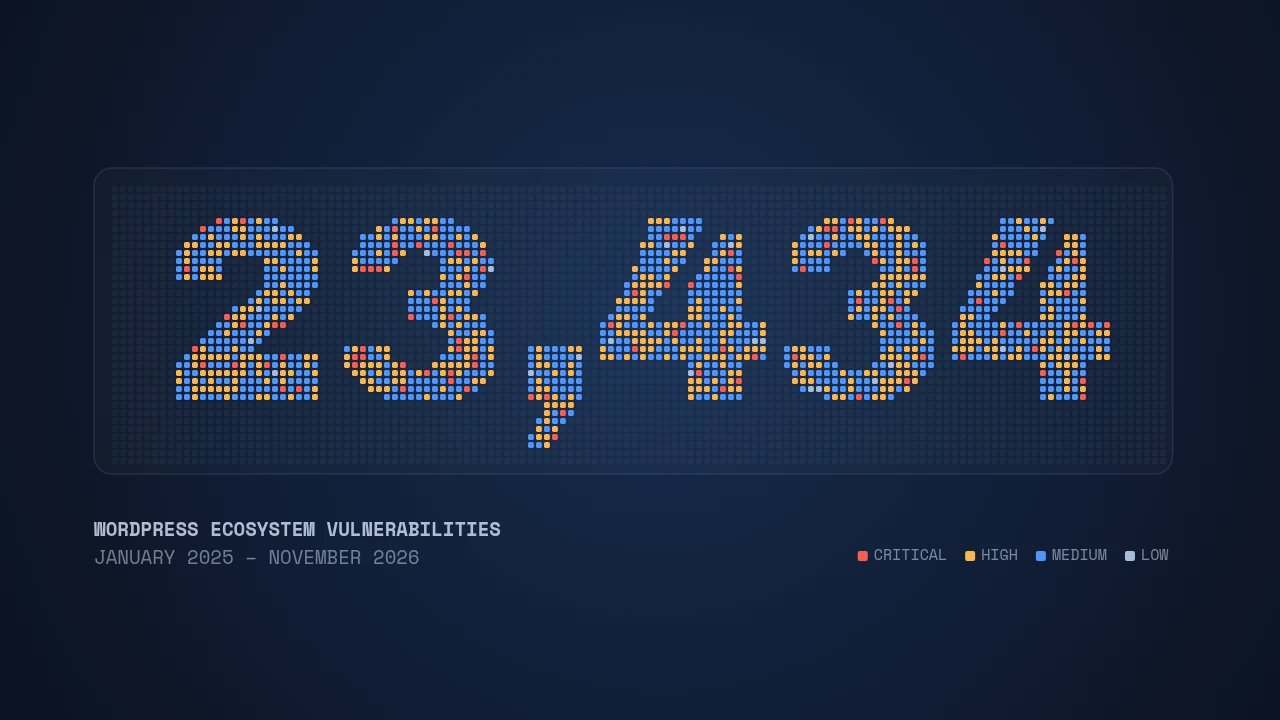
Between 1 January and 20 November 2026, 12,372 new vulnerabilities were published across the WordPress ecosystem: WordPress itself and the plugins and themes that run on it. That's already more than the 11,062 published in the whole of 2025, and 29% more than the same stretch of last year.
Numbers like that make scary headlines, so I analysed all 23,434 WordPress ecosystem vulnerabilities published since January 2025 and checked every affected plugin and theme against WordPress.org. The picture is less dramatic than the headline. Almost all of them are in plugins, most get fixed and only a small share are known to have been attacked. More people are looking, many of them with AI tools, so more is being found. But a few things changed in 2026 that matter for anyone running a site, and the data points to a few simple habits that deal with most of the risk.
I write the weekly This week in WordPress roundup, so I usually see these reports one at a time. This is the bigger picture. The data runs to 20 November 2026, and the method is at the end if you want to check my working.
12,372
WordPress ecosystem vulnerabilities published from 1 January to 20 November 2026, up 29% on the same period of 2025
99.9%
were in plugins and themes rather than WordPress itself
3,040
serious bugs that need no login, more than double the total for 2025
1 in 5
2025 and 2026 bugs in plugins with under 1,000 installs still have no newer version
How many WordPress ecosystem vulnerabilities were found in 2026?
By 20 November, 12,372 new WordPress ecosystem vulnerabilities had been published in 2026, compared with 11,062 in all of 2025.1 The first five months were quieter than 2025. Then it took off. Every month from June to September topped 1,000, October was the busiest month in this data with 2,329, and the first 20 days of November added another 1,252.
New WordPress ecosystem vulnerabilities published each month
| Jan 25 | 1,549 |
|---|---|
| Feb 25 | 823 |
| Mar 25 | 1,125 |
| Apr 25 | 1,360 |
| May 25 | 924 |
| Jun 25 | 778 |
| Jul 25 | 430 |
| Aug 25 | 621 |
| Sep 25 | 829 |
| Oct 25 | 692 |
| Nov 25 | 660 |
| Dec 25 | 1,271 |
| Jan 26 | 952 |
| Feb 26 | 751 |
| Mar 26 | 1,027 |
| Apr 26 | 530 |
| May 26 | 570 |
| Jun 26 | 1,093 |
| Jul 26 | 1,166 |
| Aug 26 | 1,351 |
| Sep 26 | 1,351 |
| Oct 26 | 2,329 |
The rise started in June, and the people closest to it put much of it down to AI. Researchers now point AI tools at plugin code and get back far more findings than a person could manage alone. Wordfence launched its own AI research system, Argus, in late August.2 WordPress's own bug bounty programme on HackerOne, which covers WordPress itself rather than plugins, used to get 20 to 30 reports a month. In July it got 450, and in August 773.3
More bugs found isn't the same as more sites hacked. Every bug in this data was reported by someone who wanted it fixed, and most of the ones I could check now have a newer version. A bug that a researcher finds and the developer fixes can't be used against any site that has installed the fix.
Who finds them
Few platforms have anything like WordPress's security research scene. Three security companies specialise in it, each allowed to issue official CVE numbers.4 Two of them pay researchers for valid plugin and theme bugs, and Wordfence's programme covers serious bugs in plugins with as few as 25 active installs.56 Patchstack published 46% of this year's WordPress ecosystem CVEs, Wordfence 33% and WPScan, which is owned by Automattic, 19%.
That's a big reason WordPress's numbers are so high. Its plugins get more scrutiny than almost any other software, and most of what's found gets a CVE number. I'll come back to this when comparing WordPress with other platforms.
Where are the vulnerabilities: plugins, themes or WordPress itself?
Almost all of them are in plugins. In 2026, 90.5% were in plugins, 9.4% in themes and just nine, less than 0.1%, in WordPress itself. Those nine, and the many WordPress fixes that never got a CVE number, get their own section below.
Premium plugins and themes are part of the picture too. At least one in seven of this year's plugin and theme bugs were in ones that aren't on WordPress.org at all, most of them probably paid products. Patchstack, counting the reports it received rather than published CVEs, found premium components made up 29% of them in 2025, with three times as many known-exploited vulnerabilities as free ones.7 Premium plugins usually update from their developer's own servers, so if a licence lapses, the fixes quietly stop arriving.
What were the nine bugs in WordPress itself?
Bugs in WordPress itself matter more than most, because every WordPress site runs that code. Nine got CVE numbers in 2026, but that's only part of the story. WordPress put out nine security releases this year, and between them the release posts list 77 security fixes.8 The other 68 had no CVE number by 20 November. WordPress doesn't issue CVE numbers itself. Its security team announces fixes in the release posts, and a CVE number only appears if one of the organisations allowed to assign them is asked for one, usually by whoever found the bug.4 For this year's nine, WPScan assigned two, Wordfence three, Patchstack one and HackerOne, which runs WordPress's bug bounty programme, the other three. That's also why the two numbers both being nine is a coincidence: four of the releases have no CVEs at all.
77
security fixes listed across nine WordPress releases in 2026
9
of them had CVE numbers by 20 November
0
were made public before a fix was out
4
were attacked, at least two of them within hours of the fix
The pace picked up sharply after the security team launched its Core Security Initiative at the end of August.9 Five of the nine releases came in the nine weeks after it, and the team now aims to put one out every three weeks.10 It says more than 50 of the fixes since mid-July were for critical or high-severity bugs.3 The latest, WordPress 7.1.5 on 18 November, fixed 20 issues, including one that could let someone without an account run their own code.8
Security fixes listed in each WordPress release, 2026
| 6.9.2 | 10 |
|---|---|
| 7.0.2 | 2 |
| 7.0.3 | 12 |
| 7.0.4 | 1 |
| 7.1.1 | 11 |
| 7.1.2 | 1 |
| 7.1.3 | 7 |
| 7.1.4 | 13 |
| 7.1.5 | 20 |
These are the nine that did get CVE numbers.
| Fixed in | What it was | Who could use it | Severity | Attacked? |
|---|---|---|---|---|
| 6.9.2, 10 March | Any logged-in user could add notes to any post, including private ones (CVE-2026-3906) | Any account, even a Subscriber | Medium | No |
| 7.0.2, 17 July | A database query that plugins use could let commands slip into the database (CVE-2026-60137) | No login, if a plugin or theme passes visitor input into it | Medium | Yes |
| 7.0.2, 17 July | A mix-up in the REST API that, combined with the bug above, let someone run their own code (CVE-2026-63030) | No login | Critical | Yes |
| 7.0.3, 6 August | Harmful code on the login screen that could be escalated to running code (CVE-2026-64638) | No login, but someone has to be tricked into visiting a malicious site | High | No |
| 7.0.3, 6 August | Harmful code via Quick Edit, on sites with a large number of users (CVE-2026-114570) | Contributor account | Medium | No |
| 7.0.4, 12 August | Running code by uploading a booby-trapped PostScript file, on servers with Imagick and Ghostscript (CVE-2026-65640) | Author account | High | No |
| 7.1.2, 22 September | Making WordPress load a PHP file from elsewhere on the server, which on some setups means a takeover (CVE-2026-87902) | No login | High | Yes |
| 7.1.3, 6 October | Comments on private and unpublished posts could be read (CVE-2026-66666) | No login | Medium | No |
| 7.1.4, 28 October | Running code in the few seconds a WordPress update takes (CVE-2026-119977) | No login | High | Yes |
How quickly were they fixed?
Every one of the nine was fixed on or before the day its details were made public. Fixes went out for every affected version, all the way back to WordPress 4.7 where needed, and sites on the default settings install security releases like these by themselves.8
The gap between a fix and the first attacks was short. CISA confirmed attacks on the two bugs fixed in 7.0.2 four days after the release.11 For the bugs fixed in 7.1.2 and 7.1.4, security companies saw attackers trying them within hours.1213 That's why the automatic updates matter so much.
CVE numbers can also turn up late. The Quick Edit bug was fixed on 6 August but only got its CVE number on 22 October,1 so counts of CVEs in WordPress itself always lag behind the fixes.
What kinds of bugs are they?
The most common kind lets someone add harmful code to a page (known as cross-site scripting, or XSS), which then runs in the browser of whoever views it. If that's an administrator, the code can act with their permissions. Close behind are plugins that forget to check whether someone is allowed to do something before doing it, such as changing settings or reading other customers' orders.
In plain English, the rest of the list is:
- Uploading, reading or deleting files. Getting a file onto your server that shouldn't be there, or reading or deleting one, such as your configuration file.
- Database injection (SQL injection). Sneaking commands into a database query, often to read data.
- Running code on the server. The worst kind. Someone can run their own code, which usually means taking over the site.
- Taking over accounts. Logging in as someone else, or giving yourself more powers than you should have.
- Tricking a logged-in user (cross-site request forgery). Getting an administrator to click a link that quietly does something on their behalf.
The mix shifted in 2026
The kinds of bugs being found changed noticeably this year. Harmful-script bugs fell from 41% to 30%, and bugs that trick a logged-in user from 14% to under 4%. Missing permission checks, account takeovers and code-running bugs all grew.
I think two things are behind this. AI tools are good at following how a plugin's pieces fit together, which is how you find a missing permission check or a way to take over an account. And bounty rules reward impact: Wordfence's programme saves its biggest payouts for serious bugs, so that's what many researchers now hunt for.5
Who can use them?
This is the question that matters most for your site, and the answer changed a lot in 2026. Almost every published vulnerability comes with a score that records whether an attacker needs to be logged in, and whether someone else has to click something for the attack to work.14
In 2025, most bugs needed either an account on the site or for someone to be tricked into clicking a link. In 2026, 42% could be used by anyone, with no login and no help, nearly double the year before.
A third of this year's bugs need a low-level account, and about one in ten an admin-level one. Where Wordfence spelled out which one, 46% needed at least a Contributor account and 37% only a Subscriber account, the lowest level there is. That second group matters most for shops, membership sites and forums, because on a site that allows sign-ups, anyone can get a Subscriber or customer account. On a site where only your own team logs in, a large slice of this list doesn't apply.
Bugs that need an administrator account were just under 10%. Someone with admin access can already change almost anything, so for most sites these are the least worrying.
Tick whatever applies to your site to see how many of this year's bugs could be used against it.
If a plugin on your site has a bug, could it be used against you?
57 in 100 of 2026's WordPress ecosystem vulnerabilities could be used against a site set up like this, if it ran the affected plugin
- No login needed 41.8%
- No login, but someone has to click a link or visit a page 14.6%
- A customer or subscriber account 13.2%
- A contributor or author account 19.2%
- Another custom role, such as vendor or instructor 1.7%
- An admin account 9.5%
Bugs that need an admin account are left out, because anyone with that access already controls the site. The split between low-level accounts follows the bugs where Wordfence named the role.
How serious are they?
Each vulnerability gets a severity rating of low, medium, high or critical.14 Most are medium, but the serious end grew in 2026.
The number I'd watch is serious bugs (high or critical) that need no login and no help from anyone. They're the ones attackers can find and use automatically, across many sites at once. There were 1,435 in the whole of 2025. By 20 November 2026 there had been 3,040, a quarter of everything published this year.
Serious bugs needing no login, published each month
| Jan 25 | 111 |
|---|---|
| Feb 25 | 101 |
| Mar 25 | 103 |
| Apr 25 | 152 |
| May 25 | 156 |
| Jun 25 | 146 |
| Jul 25 | 94 |
| Aug 25 | 122 |
| Sep 25 | 47 |
| Oct 25 | 95 |
| Nov 25 | 103 |
| Dec 25 | 205 |
| Jan 26 | 182 |
| Feb 26 | 151 |
| Mar 26 | 384 |
| Apr 26 | 53 |
| May 26 | 123 |
| Jun 26 | 428 |
| Jul 26 | 241 |
| Aug 26 | 419 |
| Sep 26 | 224 |
| Oct 26 | 605 |
This isn't one company changing how it scores bugs. The share needing no login and no help rose at all three: from 20% to 44% of Patchstack's, 27% to 36% of Wordfence's and 11% to 46% of WPScan's.
How many are actually attacked?
Very few, as far as anyone can tell. CISA, the US government's cyber security agency, assesses new CVEs and marks 5.2% of 2026's WordPress ecosystem vulnerabilities as having exploit code or a well-known method of attack in circulation, and only four as being actively attacked.15 Its list of vulnerabilities known to be attacked has four WordPress entries from 2026, all in WordPress itself, and none of the 23,000 plugin and theme bugs in this data.11
That last figure under-counts, because government lists rarely track individual plugins. The security companies' own reports fill the gap, and they show a consistent pattern this year:
- Elementor Pro (more than 6 million sites): attackers started trying an upload bug on 19 August, the same day the fix came out.16
- Super Forms (about 13,000 sites): attacks started within a week of the fix in July, and were still going in September.17
- Ninja Forms (about 500,000 sites): a campaign Patchstack spotted in early October used booby-trapped form submissions to create hidden admin accounts on sites that hadn't updated.18
- WordPress itself: attackers probed sites for a critical bug within hours of the 7.1.2 fix on 22 September.12
When a bug is attacked, it's usually soon after it's published, because the fix shows attackers where to look. Looking at the 2025 vulnerabilities it saw attacked, Patchstack found about half of the high-impact ones were first hit within a day, with a median of five hours once weighted by how heavily each was attacked.7 The sites that get caught are the ones that haven't installed the fix yet, which is why how quickly you update matters far more than how many bugs a plugin has had.
Do the bugs get fixed?
Mostly, yes. I checked every plugin and theme with a 2025 or 2026 vulnerability that's on WordPress.org, including ones since closed, against its latest version on 21 November 2026.19
Seven in ten of those bugs now have a newer version out, which usually contains the fix. About one in fifteen are in plugins that are still listed but haven't released anything since.
More than one in five are in plugins that WordPress.org has closed, 83% of them for a security issue.1920 Some reopen once the developer fixes the problem, but these were still closed on 21 November. Closing a plugin stops new downloads, but it doesn't remove it from sites that already have it, and WordPress doesn't always warn you. Those sites keep running the vulnerable code until someone notices. My guide to closed and abandoned plugins covers how to spot them and what to do.
The warning sign is easy to see. A plugin that hasn't been updated for a year can't have fixed anything reported since, and 81% of the bugs still waiting for a newer version are in plugins like that. Every plugin's page on WordPress.org, and the Plugins screen in your dashboard, shows when it was last updated.
Are popular plugins safer than small ones?
They have bugs too, but they're far more likely to get fixed. Most bugs are in small plugins. Among plugins still listed on WordPress.org, 60% of the bugs were in ones with fewer than 10,000 active installs. Closed plugins aren't included, because WordPress.org no longer shows their install numbers.
Size makes a big difference to whether a bug gets fixed. In plugins with under 1,000 installs, one bug in five has no newer version. Above 100,000 installs, it's one in 200.
How often is a reported bug left without a fix?
How many active installs does the plugin have?
1 in 5 21.5% of the 2025 and 2026 bugs in plugins this size still had no newer version on 21 November 2026
- Under 1,000: 1 in 5 (21.5%)
- 1,000 to 9,999: 1 in 19 (5.4%)
- 10,000 to 99,999: 1 in 71 (1.4%)
- 100,000 to 999,999: 1 in 200 (0.5%)
- 1 million or more: 1 in 200 (0.5%)
42 of the 67 plugins with a million or more active installs had at least one vulnerability published in 2026.19 Nearly all of those bugs already have a newer version out.
The weak link with popular plugins is the gap between the fix and sites installing it. I looked at the 155 plugins with 100,000 or more installs that released a newer version after a serious bug this year. On the median plugin, at least one site in nine was still running a version from before the fix in November, and only 54% were on its latest version branch.21 That's the gap the attackers above were aiming at.
Which kinds of plugins have the most bugs?
Shop plugins had the most, followed by page builder add-ons, bookings, forms and memberships. Most of those take information from visitors, and membership plugins and many shops let visitors create accounts, which ties back to the Subscriber-level bugs above. Page builder add-ons often bundle dozens of widgets, each with its own settings to get wrong.
These shares partly reflect how many plugins of each type exist, so they're not a ranking of how risky each type is. But if your site runs a shop, bookings or memberships, it's worth being especially picky about the plugins that power them.
How does WordPress compare with other platforms?
WordPress has far more published vulnerabilities than any other content management system. In 2026 so far it's 12,372, against 436 for Joomla and 330 for Drupal.1 That's mostly down to two things: size and scrutiny.
WordPress runs 57.4% of all websites that use a known content management system,22 and there are more than 75,000 free plugins in its directory alone.19 And as above, it has three specialist security companies counting bugs, and Wordfence pays bounties for bugs in plugins with as few as 25 installs. Drupal, by comparison, generally only issues CVE numbers for projects with more than 10,000 reported installs, and handles the rest on a reasonable-effort basis.23
Adjust for size, and WordPress sits in the middle of the pack among platforms you install and run yourself. It has fewer published vulnerabilities for each percentage point of market share than Drupal or Joomla, though more than TYPO3, OpenCart and PrestaShop. The order moves around from year to year, though. Joomla's count jumped ninefold in 2026, so on last year's counts WordPress would have had more per point of market share than Joomla. Treat it as a rough guide.
Hosted platforms such as Shopify, Wix and Squarespace aren't in this chart, because a count wouldn't mean anything. More on why below. Magento is left out because W3Techs groups it with Adobe's other products, and Craft CMS, Concrete CMS and Umbraco because their market shares are too small to divide by reliably.
Did other platforms see the same rise?
Yes, and most saw a bigger jump than WordPress. Of the open-source platforms I looked at, only OpenCart and Umbraco stayed flat. Joomla, whose security team assigns CVEs for extensions as well as its core,24 went from 47 to 436. Reviewed security advisories for npm, the main JavaScript package registry, rose sevenfold.25
npm also had more than 15,000 malicious packages reported this year, deliberately harmful code published to look like something useful.25 WordPress.org now checks every plugin and theme update for this kind of thing, as the next section explains.
What about Shopify, Wix and Squarespace?
You can't compare hosted platforms on these numbers, because they have little reason to publish CVEs. A CVE exists so that people running a piece of software know to update it. On Shopify, Wix or Squarespace, the company runs the only copy of the platform, so when it fixes a bug, every site is fixed at once and there's nothing for customers to do. I found one CVE in Wix's own platform since the start of 2025, and none for Shopify or Squarespace.1
That doesn't mean they have no bugs. Shopify has paid researchers more than $10 million through its bug bounty, $1.9 million of it this year.26 Fixes that arrive without you doing anything are a real advantage if you want a simple site and never want to think about updates.
The trade-off is control. You rarely see what was fixed and you can't easily move your site elsewhere. The apps you add are still written by other companies, and Shopify's bug bounty doesn't pay out for bugs in them.26
What is WordPress.org doing about it?
Quite a lot, and most of it is new this year. Since 5 June 2026, every plugin and theme update in the WordPress.org directory has waited six hours before going out to sites. In that time, several AI models and Jetpack Scan check what's changed and give it a risk score. Since September, updates with a high score have been blocked automatically until the developer fixes them.27
- Update released A developer publishes a new version
- Six-hour review AI models and Jetpack Scan check the changes
- Sent or held back Low-risk updates go out, high-risk ones are blocked
It has already earned its keep. On 28 July, someone slipped a backdoor into an update for a plugin with around 20,000 active installs. The review flagged it, and that update was never sent to a single site.27 It isn't only looking for malware. The author of the announcement says a large share of what it flags is output that hasn't been made safe or a missing permission check,27 the two most common kinds of bug in this data.
It has limits. It only covers plugins and themes delivered through WordPress.org, so premium plugins that update from their own servers aren't checked. And it's too new to show up in these numbers, which count bugs found in code that had already been released.
What this means for your site
Put all of that together and the risk to a typical business site comes down to a handful of habits, most of which cost nothing.
- Let security fixes install themselves Keep automatic updates on for WordPress itself, and switch them on for plugins you trust. Attacks on serious bugs often start within hours or days of a fix
- Fewer plugins, better plugins Every plugin is code someone else wrote. Remove anything you don't use, and favour well-maintained plugins with plenty of active installs
- Check when a plugin was last updated A plugin that hasn't been updated for a year can't have fixed anything reported since, and that's where four in five unfixed bugs sit
- Be careful who can sign up About a third of this year's bugs need a low-level account, and many need only the kind anyone gets by signing up. If your site doesn't need open registration, switch it off
- Keep premium licences renewed Premium plugins and themes usually update from their developer's servers. If the licence lapses, the security fixes stop arriving
- Have a backup you've tested If the worst happens, a recent off-site backup turns a disaster into an inconvenience
When a vulnerability does turn up in something you use, my guide to handling a plugin security vulnerability walks through what to do. If you think a site has already been attacked, start with cleaning up a hacked WordPress site. And if you'd like to hear about the serious ones each week, my weekly roundup flags the ones being attacked.
My take
WordPress's numbers are high because it's big and heavily checked, and most of the bugs that matter get fixed. The real risk to your site is a plugin that has stopped getting updates, or a fix you haven't installed yet.
How I collected this data
I pulled every CVE published between 1 January 2025 and 20 November 2026 from the US National Vulnerability Database (NVD):1 everything issued by Patchstack, Wordfence and WPScan, plus WordPress core bugs reported through HackerOne and anything else that mentions WordPress. After removing rejected records and ones that only mention WordPress in passing, that left 23,434 vulnerabilities. Then I worked out the rest from each record and a few other public sources:
- Plugin, theme or WordPress itself from the description and links on each CVE record.
- Kind of bug from the weakness code (CWE) on each record, grouped into plain-English categories.
- Severity and what an attacker needs from the CVSS score the reporting company published, which records whether a login is needed and whether someone has to click something.14
- Attacks from CISA's Vulnrichment assessments, which it adds to each CVE record,15 and its Known Exploited Vulnerabilities list.11
- Fixes, installs, tags and last updates from the WordPress.org plugin and theme APIs on 21 November 2026.19 Where a plugin's latest version is newer than the last affected one, I count it as a newer version released. That usually means the bug is fixed, but not always, so treat those figures as a best case.
- Sites still on old versions from the share of active installs on each version branch, which WordPress.org publishes for every plugin.21 Sites on a branch older than the last affected version are counted as running a version from before the fix. Smaller branches are grouped as "other" and left out, so the real figure is higher.
- WordPress's own security releases from the release post for each version on WordPress.org, counting each listed security item. Some items cover several bugs, and a few are hardening changes rather than fixes.
- Other platforms from the same NVD data, searched by platform name with WordPress plugins that merely mention another platform removed, and W3Techs market share figures for 21 November 2026.22 Package registries use GitHub-reviewed advisories and malware reports from the OSV database.25
A few limits are worth knowing. A CVE count measures how much has been found and reported, not how dangerous a platform is, and one bug can matter to millions of sites or to none. Premium plugins aren't on WordPress.org, so the fix and install figures only cover free plugins and themes. Market share figures are estimates, so treat the per-share comparison as a rough guide. A few hundred records are older bugs that were only given a CVE number recently. Monthly counts are lumpy because the reporting companies sometimes publish in batches. Severity scores come from the companies that report the bugs, several of which also sell protection. And my scripts will have put some records in the wrong group: a few dozen I couldn't classify at all are counted as plugins, and I haven't hand-checked every record. I'll update this post as more data comes in.
This post uses data from the NVD API but is not endorsed or certified by the NVD.
Common questions
Is WordPress secure?
WordPress itself, yes. Only nine of the 12,372 vulnerabilities published in 2026 were in WordPress itself, and its security releases install automatically on the default settings, though four of those nine were attacked, so updates matter. The real risk sits in plugins and themes, and depends mostly on how many you use, how well they're maintained and how quickly updates are installed.
Why does WordPress have so many more vulnerabilities than other platforms?
Mostly size and scrutiny. WordPress runs well over half of all sites that use a content management system and has more than 75,000 free plugins. Three specialist security companies hunt for bugs in them, and Wordfence pays researchers for finds in plugins with as few as 25 installs. Adjusted for market share, WordPress sat mid-table in 2026, with fewer than Drupal or Joomla but more than TYPO3, OpenCart or PrestaShop.
How quickly are vulnerabilities attacked after they're published?
When they're attacked at all, often within a day. Of the 2025 vulnerabilities Patchstack saw attacked, about half of the high-impact ones were first hit within 24 hours, and in 2026 attackers went after an Elementor Pro bug the same day it was fixed. That's why automatic updates for security fixes matter more than anything else here.
Is Shopify or Wix more secure than WordPress?
Not necessarily, and these numbers can't tell you. Hosted platforms publish almost no vulnerabilities because the company fixes the platform centrally, so there's nothing for you to update. That's a real advantage for simple sites. It doesn't mean they have no bugs, as Shopify's bug bounty has paid out more than $10 million,26 and the apps you add are still written by other companies.
CVE API, US National Vulnerability Database (NIST). All CVE records published 1 January 2025 to 20 November 2026, retrieved 21 November 2026. ↩ ↩ ↩ ↩ ↩
Wordfence Argus: Moving Beyond Human Research Capability, Wordfence, 27 August 2026. ↩
The Core Security Initiative: two months in, Make WordPress Security, 29 October 2026. ↩ ↩
List of CVE Numbering Authorities, CVE Program. Patchstack, Wordfence and WPScan are each listed with WordPress in their scope, HackerOne assigns CVE numbers for the bug bounty programmes it runs, and WordPress itself isn't listed. Checked 21 November 2026. ↩ ↩
Enhancing the Wordfence Bug Bounty Program: New Incentives & a Stronger Focus on High-Impact Research, Wordfence, 3 March 2025. ↩ ↩
Patchstack Bug Bounty, Patchstack, checked 21 November 2026. ↩
State of WordPress Security in 2026, Patchstack, 25 February 2026. ↩ ↩
WordPress.org release posts for each 2026 security release: 6.9.2 (10 March), 7.0.2 (17 July), 7.0.3 (6 August), 7.0.4 (12 August), 7.1.1 (17 September), 7.1.2 (22 September), 7.1.3 (6 October), 7.1.4 (28 October) and 7.1.5 (18 November). ↩ ↩ ↩
The Core Security Initiative, Make WordPress Security, 28 August 2026. ↩
WordPress 7.1.5 Patches 20 Vulnerabilities as Security Team Aims for a Release Every Three Weeks, The Repository, 19 November 2026. ↩
Known Exploited Vulnerabilities Catalog, CISA, checked 21 November 2026. ↩ ↩ ↩
CVE-2026-87902: Attackers Started Probing WordPress Sites Hours After the Patch, Patchstack, 22 September 2026. ↩ ↩
WordPress 7.1.4 Patches Unauthenticated Upgrade-Window RCE; Exploitation Attempts Detected After Release, Wordfence, 29 October 2026. ↩
CVSS v3.1 Specification Document, FIRST. ↩ ↩ ↩
CISA Vulnrichment, CISA, and the Exploitation decision point, SSVC, CERT Coordination Center. Both checked 21 November 2026. ↩ ↩
Attackers Actively Exploiting Critical Vulnerability in Elementor Pro Plugin, Wordfence, 2 September 2026. ↩
Attackers Actively Exploiting Critical Vulnerability in Super Forms Plugin, Wordfence, 3 September 2026. ↩
Four ways back in: the WordPress XSS campaign that hides its own admin account, Patchstack, 6 October 2026. ↩
Plugins and Themes directories, WordPress.org, read through the WordPress.org API on 21 November 2026. ↩ ↩ ↩ ↩ ↩
Detailed Plugin Guidelines, WordPress.org, updated 11 March 2026. ↩
Active versions for each plugin from the WordPress.org plugin stats API (WooCommerce shown as an example), the same data as the "Active versions" chart on each plugin's Advanced View page. Checked 21 November 2026. ↩ ↩
Usage statistics of content management systems, W3Techs, 21 November 2026. ↩ ↩
CVE assignment, Drupal Security Team, updated 22 May 2026. ↩
Joomla! Project, CVE Program partner listing, which gives its scope as the Joomla! CMS, Framework and Extensions. Checked 21 November 2026. ↩
OSV data dumps for npm, PyPI and Packagist, OSV. GitHub-reviewed advisories from the GitHub Advisory Database (licensed CC BY 4.0) and malicious package (MAL) reports, retrieved 21 November 2026. ↩ ↩ ↩
Shopify Bug Bounty, Shopify, which showed $10,497,611 in total bounties paid and $1,883,608 paid this year when checked on 21 November 2026, and its programme criteria, which exclude third-party apps. ↩ ↩ ↩
Automated security review for plugin releases, Make WordPress Plugins, 9 September 2026, including the author's reply to comments on 12 September 2026. ↩ ↩ ↩