The biggest delay on any web project I've worked on has never been the code. It's the content. You build the site, hand over the content checklist, and then you wait. Sometimes for weeks, sometimes for months. The "almost ready to launch but still waiting on the about page" project has been a constant in my career.
Now that LLM tools are seemingly ubiquitous (whether we like it or not), clients who used to agonise over every sentence can pull together a first draft in an afternoon. People who didn't know where to start describing their own business have something to push against. Briefs are sharper, projects move faster, and the perma-stalled "we'll send the copy next week" loop has properly broken.
So that's the good news. The other side of it is that working with AI-generated content is its own thing, and the wider AI push from platforms like WordPress is shifting the job in ways I think are worth talking about.
The voice problem
When clients write their own copy, even roughly, you can hear them in it. The sentences might need some refinement or perhaps the structure does not fit the design vision, but there's a real human voice underneath. Tidying that up while keeping what makes it theirs is fairly easy.
AI copy is the opposite. It's clean, well-structured, and grammatically tidy. It just sounds like nobody. Every business ends up "passionate about delivering excellence." Every about page opens with "in today's fast-paced world." It reads like every other business website you've ever seen, because in a sense it kind of is.
What works for me is treating the AI draft as scaffolding rather than the finished thing. The structure is usually fine. The headings make sense. But the actual voice has to come from the client, and you don't get that from a brief.
This is partly why I always push for video meetings rather than trading emails. You pick up so much from a conversation that never makes it onto a page. How they actually describe what they do when they're not trying to sound like a website. What they think their competitors get wrong. The bits of their work they have strong opinions about. That's the stuff AI doesn't know, because it's not in the brief and it's not in their existing copy. Getting a real sense of how a client thinks about their own work, then weaving that into the AI's structure, is how you end up with a site that sounds like the business it represents.
If you're a client reading this: your actual expertise and opinions are the thing that makes you different. AI will give you the bones. You're the only one who can give it any kind of point of view.
The mockups, though
Clients have always turned up with links or screenshots of websites they like and now some of them turn up with AI-generated mockups too. I'll be honest, I haven't seen a good one yet. They might look slick at first glance but fall apart the moment you look properly. No thought given to responsive behaviour, no consideration of what happens with real content, navigation that doesn't make sense, layouts that only work on a thirty-inch monitor with exactly four words of copy per section. They're pictures of websites rather than websites, and the gap between those two things is huge.
They're not useless. If a client shows me one I can at least see roughly where their head is at: dark theme, lots of whitespace, big typography, whatever. That's more useful than "I want it to look modern and clean." We just need to move past the mockup quickly and into proper design decisions that account for actual content and actual screens.
The functional prototypes are more interesting to me. I've had a couple of clients turn up with rough working prototypes for things like calculators or quote builders that they've put together with ChatGPT or Claude. The code is usually a mess and would need rebuilding properly, but as a way of saying "this is the tool I want, and roughly how it should work," it's genuinely helpful. Trying to describe interactive functionality in an email is hard. A working prototype, even a janky one, communicates the idea in a way prose can't.
WordPress and the "agentic web"
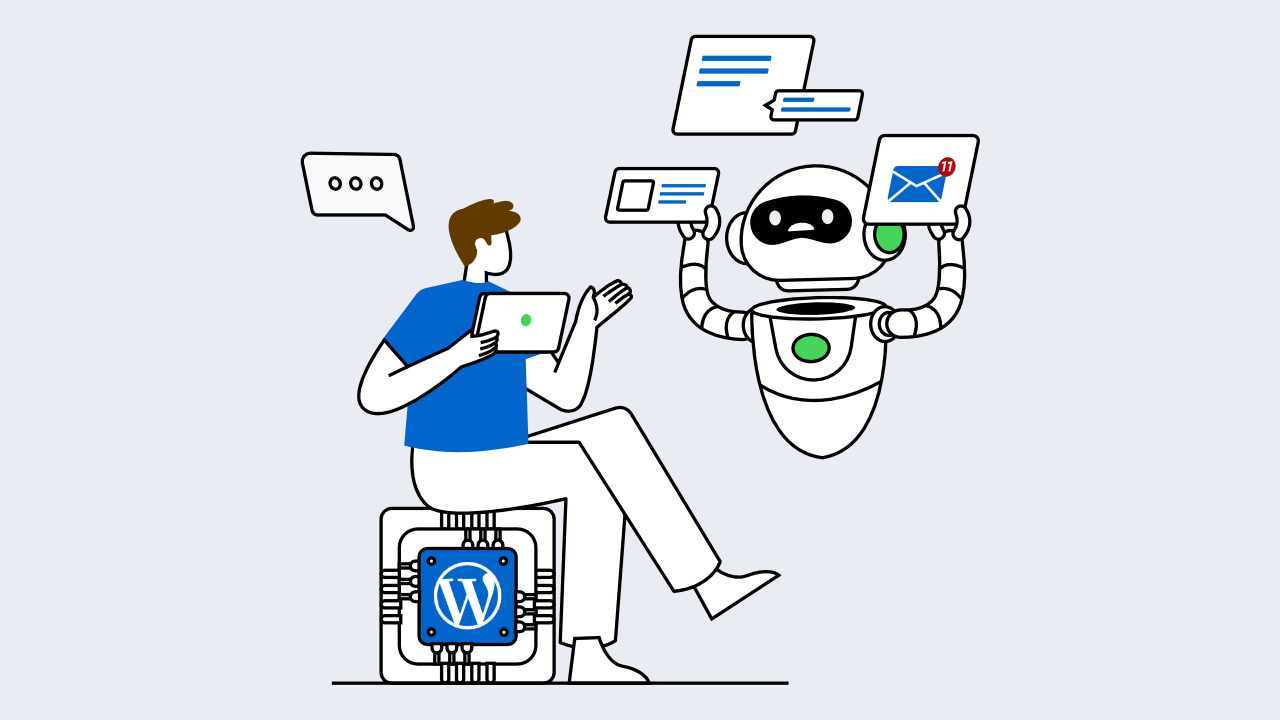
Automattic recently published a post calling WordPress "the operating system of the agentic web", which is a hell of a statement. The argument is that WordPress's open codebase, plugin ecosystem, and new MCP (Model Context Protocol) support make it the natural foundation for AI agents to build on.
I suppose there's a technical case for it. WordPress is open source, has a mature REST API, and the volume of WordPress code available for models to learn from isn't matched by any other CMS. WordPress.com added full write capabilities through MCP in March, and 7.0's AI Connectors are laying groundwork for plugin-level AI features.
But there's quite a gap between the vision and what most of my clients actually need. The WordPress sites I build are mostly for small and medium businesses who want something fast, reliable, and easy to maintain. They don't need an agentic operating system. They need a site that loads quickly, ranks in local search, has useful features, and makes it easy for someone to get in touch. The agentic web is a really compelling pitch for a keynote but the day-to-day requests is asking if you can make the logo bigger.
The value question
The shift I find trickiest is the perception of value. When a client can generate copy, images, and a rough design with AI, it's natural for them to wonder what the rest costs. "I've already got the content and the visuals, so really you just need to assemble it, right?"
It's a fair question. The answer is that the assembly was never really the expensive part. The expensive part is working out what the site needs to do, making decisions about how it's structured, building it so it's accessible and fast, and making sure the client can run it themselves once it's launched. None of that's changed because ChatGPT can write a paragraph.
Most clients understand this once you walk through it. The ones using AI tools tend to be more engaged and proactive anyway, and they appreciate hearing where the time and thought actually goes. It's less a negotiation and more a conversation about what's involved.
Overall
I'm still an AI sceptic at heart. Given the choice, I'd take a human-written page over a machine-generated one every time. A person writing about their own business or collaborating with a professional copywriter produces something more interesting than a perfectly structured page of AI copy that could be about anyone. The rough edges are what make it feel like a real thing made by real people.
The real ethical and practical questions around AI are still being debated, and that could be an entirely separate post. For now, I'm just talking about the practical reality of working with clients who are using AI tools as part of their process. The tools are here, the clients are using them, and pretending otherwise would be daft.
Fortunately, the interesting stuff is still on the human side: getting a feel for what a business actually does, understanding what the site needs to achieve, and turning a polished but generic AI draft into something that sounds like it belongs to someone in particular. That bit hasn't changed, and I doubt it will.